Aident AI Review and Opinion
An honest review of Aident AI. Learn how the AI automation platform performs in real use. Topics include features, usability, pricing, pros, cons, and ideal use cases.

Aident AI is an AI-driven automation platform designed to take repetitive operational tasks off teams' plates. Rather than focusing on single-task automation, it aims to orchestrate more complex workflows by combining AI agents, predefined playbooks and integrations with existing tools.
In this review, I’ll take a closer look at what Aident.ai actually delivers in practice. My goal is not to repeat marketing claims but to evaluate the platform's usability, the effectiveness of its automation, and the scenarios in which it is most useful. I’ll cover the core features, setup and usability, integrations, pricing and the types of teams that would benefit most from it. I’ll also provide a clear summary of the pros and cons.
If you’re considering using aident.ai to streamline internal processes, reduce manual work or experiment with AI-powered automation beyond simple triggers, this review should help you decide whether it’s a good fit.
Overview
- It lets users describe workflows in plain language and compiles them into automations without the need for drag-and-drop wiring or coding.
- It uses an agentic system to interpret intent and orchestrate multi-step processes across tools such as help desks and chat platforms.
- We focus on small teams and business owners who lack engineering resources but want to operate on a scalable, AI-driven basis.
- One example of a use case is automating customer support by routing, summarizing, and coordinating ticket-related actions across SaaS tools.
- It emphasizes reliability and monitoring for "thousands of automation agents" that run real-world tasks.
- It includes APE (Aident Playbook Editor), a text-first workflow editor that replaces node-based builders with a conversational setup process.
Core Features and Automation Capabilities of Aident AI
At the heart of Aident AI is the idea of translating human instructions into working business automations with minimal friction. The following are its core strengths and what sets it apart from other automation tools.
Natural-language workflow creation
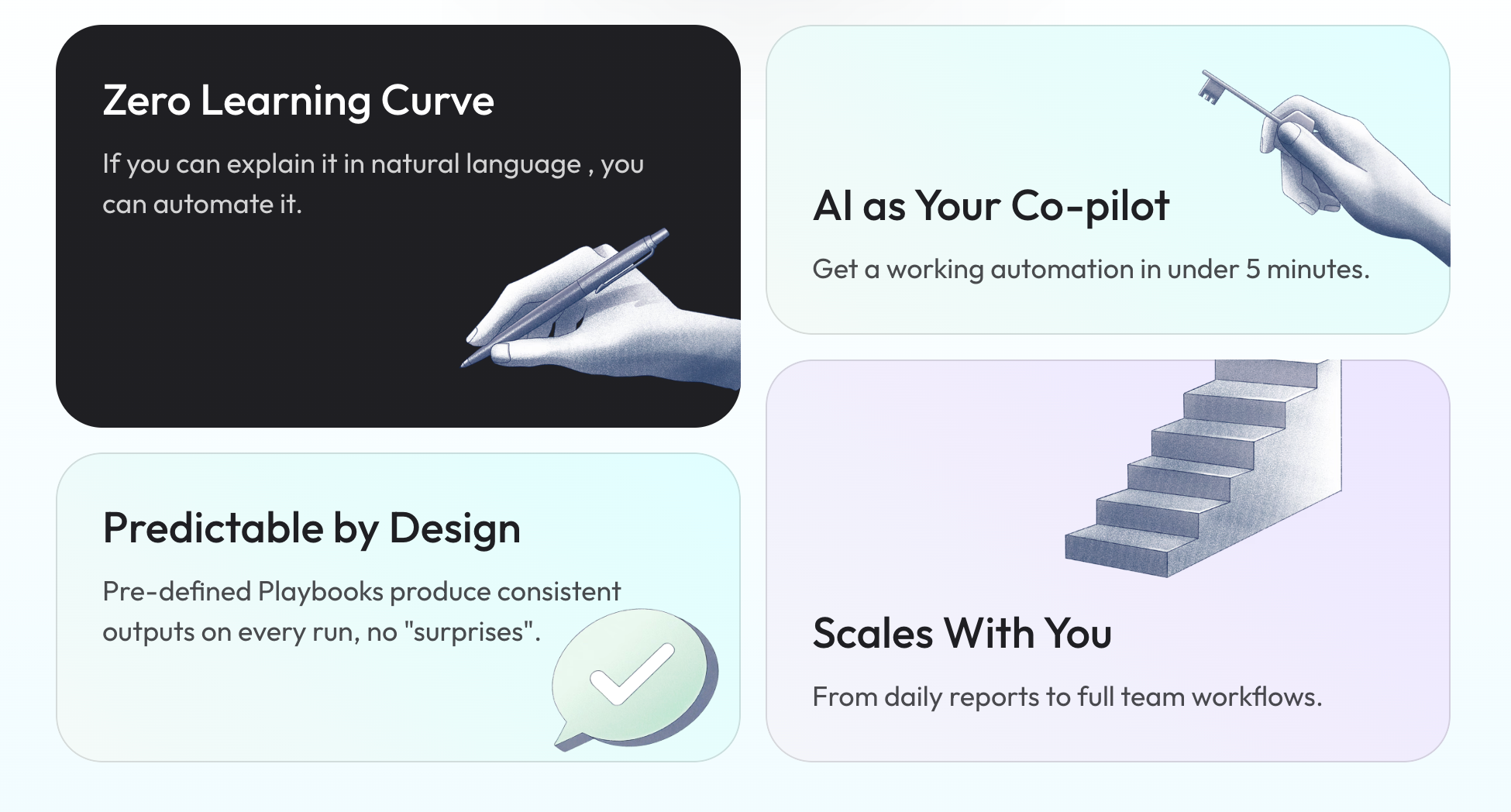
- There is no need for drag-and-drop or code writing. Aident lets you describe what you want in plain language. For example, you can say, “Send me a daily competitor-news summary”, and Aident will generate a working automation (“Playbook”) from that instruction.
- This makes the learning curve very shallow: if you can explain what you want, you can start automating.
Pre-Built and Predictable Playbooks
- Aident comes with preconfigured automation flows. These playbooks produce consistent results every time, with no surprises.
- Since they’re standardized, the risk of human error or inconsistency that can occur with manual processes is reduced.
Broad Integrations and Tool Connections
- Aident supports over 250 different business tools and more than 2,000 operations. This makes it possible to effectively bridge many parts of your tech stack by tying together marketing tools, CRM, ops platforms, and reporting tools.
- Due to this broad connectivity, you can build automations that span multiple systems, helping with data flow, consistency, and cross-team coordination.
Flexibility and scalability
- Whether you need a simple daily report or a multi-step, multi-tool workflow, Aident can handle it.
- You're not limited to one-off automations; you can build reusable workflows that evolve as your business grows.
Interactive testing, human oversight
- Before finalizing an automation, Aident lets you test and preview the output. If something doesn’t look right, you can adjust the logic, clarify instructions, and correct errors.
- For workflows that require oversight, you can insert approval steps, which give teams control and quality assurance while you still benefit from automation.
Automation for Non-Technical Users, Teams, and Organizations
- Because Aident relies on natural-language instructions and abstracts technical complexity, it is designed to empower non-technical teams, including marketers, operations teams, and administrators, to build and run automations themselves.
- This opens up automation possibilities for small businesses, lean teams, and roles where coding is not an option, yet efficiency and reliability are still important.
Setup, Interface, and Day-to-Day Usability
Getting started with Aident.ai is refreshingly straightforward. The initial setup focuses more on intent than configuration. Rather than pushing users through long technical forms or complex logic builders, the platform prompts you to describe what you want to automate. Then, Aident.ai translates your input into a working automation flow.
The interface is clean and purpose-driven. Unlike traditional automation tools, it avoids clutter and keeps the focus on workflows, actions, and outcomes. Even first-time users will find the navigation intuitive, and key actions are easy to find without digging through menus. You’re rarely more than a few clicks away from editing, testing, or running an automation.
The platform's strengths are most evident in day-to-day usage. Creating or adjusting automations feels more like refining instructions than rebuilding logic. You can review outputs, tweak steps, and rerun workflows seamlessly. This makes experimentation easy and reduces the mental burden of maintaining automations over time.
Overall, Aident.ai is clearly designed for regular use, not just initial setup. It's ideal for teams or individuals who want automation to feel like a natural extension of their workflow rather than a separate technical system that requires constant attention.
Integrations, Performance, and Reliability
Aident.ai shows its strengths in integration, performance, and reliability, as well as some early-stage caveats.
Integrations and Ecosystem
- Aident connects to a broad range of tools with over 250 integrations across marketing, operations, CRM, and more.
- This allows you to plug it into existing workflows involving spreadsheets, email tools, content platforms, CRMs, and collaboration tools, boosting its usefulness right from the start.
- This wide connectivity allows you to build cross-tool workflows for many use cases (e.g., trigger something in a spreadsheet, send an email, or update a CRM) without needing custom code or glue logic.
Performance and Reliability
- The platform is "predictable by design," meaning that once a Playbook is created, its outputs remain consistent across runs.
- Its "AI-native" architecture, which converts natural-language instructions into workflows via an agent, aims to reduce fragility compared to brittle, manually coded automations.
- According to third-party summaries, Aident’s automation engine is built on stable infrastructure powered by a background platform, which supports reliable execution, though this information is based on limited external reporting.
What to Watch Out For
- Because the product is in its early stages ("v0" at launch, according to its public presentation), users should expect potential "growing pains" or bugs, as mentioned by the developers themselves.
- As with many automation platforms that integrate many tools, the reliability of this product may depend heavily on the integrations used and the complexity of the workflow. If you use many external tools, there’s always a higher risk of a "weak link."
- Because the product relies on third-party services and web integrations, there is no publicly described guaranteed SLA, so for mission-critical workflows, you may need fallback or manual review procedures.
Pricing and Support
Aident.ai offers a tiered pricing model that starts with a free beta plan. You receive 300 "refresh credits" per month at no cost.
- Paid plans start at $6 USD per month for the Basic tier, go up to $18 USD per month for the Pro tier, and reach $60 USD per month for the Max tier, depending on how many usage credits you need.
- Credits are consumed through API calls, LLM tokens, and integrations, so the price scales with usage rather than the number of seats.
- Aident.ai includes a help/support section and documentation accessible through the platform. However, publicly available user reviews about support quality seem sparse.
(Cheaper pricing applies for annual plans.)
Best Use Cases and Ideal Users
Aident.ai is ideal for teams and individuals looking to automate repetitive knowledge work without creating complex logic or maintaining fragile workflows. Typical use cases include internal reporting, competitor monitoring, lead enrichment, content research, and lightweight operational automations that span multiple tools.
Aident AI is especially well-suited for founders, marketers, operations teams, and small-to-mid-sized companies that want the power of automation without the overhead of traditional workflow builders. For highly regulated or mission-critical enterprise processes, however, it's better viewed as a productivity layer than a full replacement for hardened automation systems.
Pros and Cons
Pros:
- Very easy to use: The chat-based input makes building automations simpler than with comparable tools that rely on complex builders or logic trees.
- Affordable pricing: Entry-level plans are affordable, so it's easy to try the tool without making a big upfront commitment.
- Flexible plan structure: Different plans cover a wide range of needs, from light experimentation to regular, automation-heavy usage.
Cons:
- Limited number of finished templates: Compared to more mature automation platforms, there are fewer ready-made playbooks available.
- Smaller integration catalog: While the available connections cover many common tools, the ecosystem is not as extensive as that of some long-established competitors.
Final Verdict
Aident AI is a user-friendly and affordable introduction to workflow automation, especially if you have a non-technical background or need a lightweight and flexible solution. Its chat-based setup drastically lowers the barrier to automating multi-tool workflows, and its affordable pricing makes it easy to test.
Currently, Aident.ai is ideal for small teams, freelancers, and companies looking to automate marketing, operations, lead generation, or reporting without significant engineering resources. While it may not yet replace a fully featured, enterprise-grade automation stack due to its limited number of prebuilt templates and smaller integration catalog, it makes up for this with its simplicity, affordability, and ease of use.
If you need simple to moderate automations and value speed and ease over comprehensive coverage, Aident.ai delivers real value. However, if you foresee needing a high number of integrations or complex, mission-critical workflows, you may want to explore more mature alternatives or use Aident.ai as a complementary tool, rather than the core.